

What is Karst?
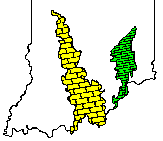
KARST is a term that was first applied to a plateau in the Dinaric Alps of Yugoslavia. It has now come to be applied to similar regions throughout the world. Such regions are characterized by the presence of limestone or other soluble rocks, where drainage has been largely diverted into subsurface routes. The topography of such areas is dominated by sinkholes, sinking streams, large springs, and caves.
Unfortunately, many karst features are subject to incompatible or damaging uses. Most are on private land, occasionally with owners apathetic to their preservation or unaware of their significance. Protection and awareness of karst features and the unique habitat they provide is what the Indiana Karst Conservancy is about.
More information on karst in Indiana.

WHY THE IKC?
Simply because
Indiana's unique karst features are in danger.
Indiscriminate use of sinkholes and pits to dump trash
and toxic materials pollutes the groundwater. Some of
Indiana's most beautiful caves suffer from the vandalism
and littering of thoughtless visitors. Critical habitat
for endangered animal species such as the Indiana Bat
often have little or no protection.
Tragically, the amount of land being misused is usually small and could have been protected at a minimal cost. This can make it possible to acquire or lease properties, and to manage the karst resource for proper use by the informed public. What may be a liability and nuisance for landowners can present real opportunities for the IKC.

STEWARDSHIP
Properties managed by
the IKC will be open to all responsible individuals or
groups, except where scientific research or other
special protection considerations (such as hibernating
endangered bats) require limited visitation. Certain
restrictions may be implemented when it is necessary to
effectively protect sensitive resources. Other logical
conservation practices such as prohibiting biological
and geological collecting (except for approved
scientific projects) are enforced.